

Problem
What needed to be understood or measured
A detection box says a crack is present; an inspection workflow often needs its pixel-level extent. This study evaluated instance segmentation as a path from survey imagery to reviewable crack masks.
My contribution
My contribution
I led the study as first author, preparing imagery and annotations, setting up data splits and augmentation, training YOLOv8 segmentation variants, and evaluating failure cases.
Experimental setup
Data and setup
Civil-infrastructure images with annotated crack regions; YOLOv8 segmentation variants trained for 20 epochs at 448 px and evaluated on a held-out split.
 Open figure —
Six crack-segmentation examples. Red is the model prediction; green is the ground-truth boundary.
Concrete Crack Detection and Segmentation in Civil Infrastructures Using UAVs and Deep Learning, Fig. 1, p. 3.Method
From input to interpretable output
A documented training entry point and portable inference script accept images, folders, video, or streams. The repository separates code from large research artifacts.
Results
Reported results
F1 score across five model sizes
522 held-out test samples
average precision across five model sizes
published comparison
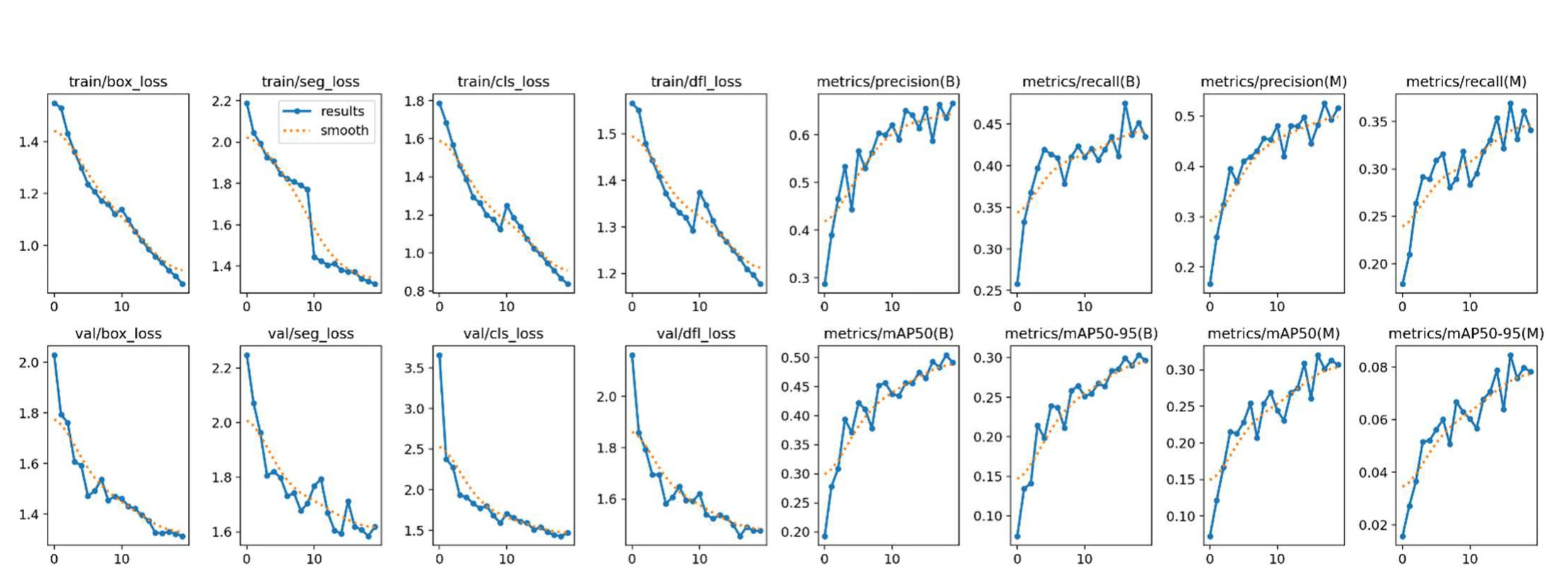 Open figure —
Training and validation traces for the medium YOLOv8 segmentation model.
Concrete Crack Detection and Segmentation in Civil Infrastructures Using UAVs and Deep Learning, Fig. 2, p. 4.Validation & uncertainty
Reference and uncertainty checks
I compared five YOLOv8 sizes on a held-out set of 522 samples. Across the models, reported F1 scores range from 0.62 to 0.64 and average precision from 0.85 to 0.87. The qualitative masks show that predictions can extend beyond the annotated crack boundaries.
Limitations & failure modes
Operating limits and failure modes
Fine cracks, surface texture, shadows, low contrast, motion blur, viewpoint changes, and annotation ambiguity can produce missed or fragmented masks.
The public repository does not include source data or trained weights. It is reproducible code, not a one-click hosted model or evidence of field deployment.
Technical stack
Tools selected for the measurement chain
- Python
- Ultralytics YOLOv8
- PyTorch
- OpenCV
- Polygon annotation
- UAV imagery
Sources & project links
Papers and code
IEEE IoT 2023 paper and public repository. Repository figures retain their publication attribution; no dataset or weights are redistributed here.