Engineering foundations. Research shaped by measurement.
My education traces a path from robotic engineering and mechatronics to doctoral research in information technology for engineering. Across each stage, my focus has moved toward making computational systems useful in the physical world: grounded in geometry, sensing, and evidence.
Robotics established the systems perspective; mechatronics added an intelligent human-machine dimension; doctoral work brought those interests into measurement, computer vision, and digital twins.
Degrees & research
Three stages of technical study.
Degrees and selected research topics.
01
2022–2025
Ph.D. in Information Technology for Engineering
University of Sannio · Benevento, Italy
Measurement and sensor information processing for digital twins, connecting computer vision, geometric measurement, and sensor data to engineering applications.
Doctoral dissertation
Measurement and Sensor Information Processing for Digital Twins
Vision-based structural monitoring
Monocular visual and visual-inertial odometry
UAV and UUV visual localization
Measurement uncertainty and sensitivity
Marker-based 6-DoF tracking
Crack detection and verification
Underwater vision and marine digital twins
02
2018
M.Sc. in Mechatronics Engineering
Specialization · Human-Machine Interaction
Islamic Azad University
Graduate study specializing in Human-Machine Interaction, with thesis work applying deep learning and transfer learning to facial expression identification.
Master’s thesis
Facial expression identification using deep convolutional neural networks and transfer learning (GoogleNet-based work)
Human-Machine Interaction
Deep learning
Facial expression identification
Transfer learning
03
2014
B.Sc. in Robotic Engineering
Islamic Azad University
Undergraduate foundation in robotic engineering, providing the starting point for later work across perception, visual localization, sensing, and engineering measurement.
Robotic engineering
Perception and sensing
Engineering systems
International research period · 2024
Underwater vision system research at Universitat Politècnica de Catalunya (UPC).
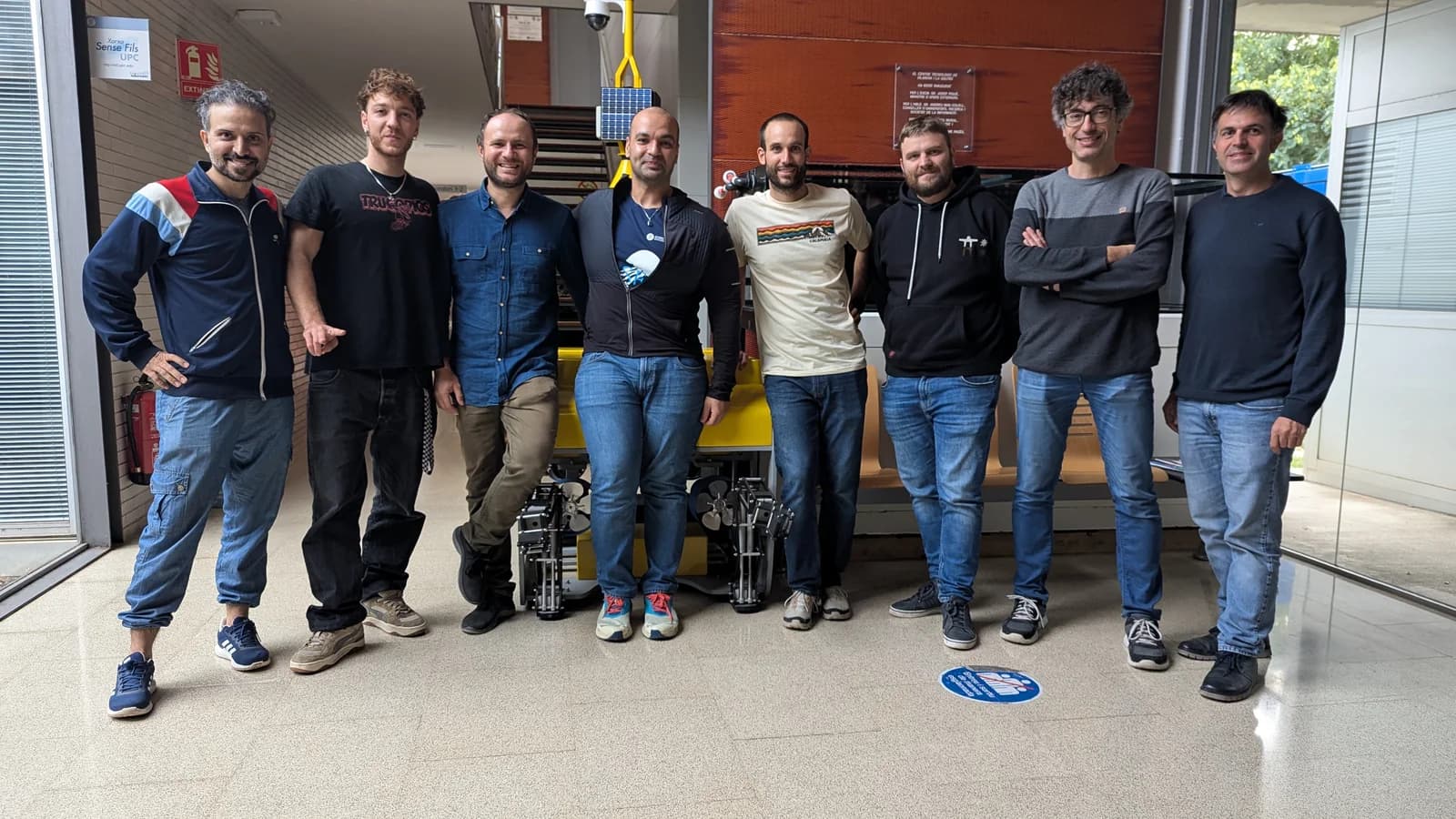
Research collaboration at UPC in OBSEA Lab, Spain.
During my doctoral research period abroad at Universitat Politècnica de Catalunya (UPC), with the Expandable Seafloor Observatory Lab (OBSEA) in Spain, I focused on underwater visual systems and monocular visual odometry.
The work included controlled underwater image acquisition and development of the SUBVO dataset with calibrated camera information and measured positional ground truth, alongside evaluation of feature extraction and visual-odometry methods in challenging underwater imagery.
Visiting researcher · April–November 2024
Education in practice
From academic training to dependable visual measurement.
This academic path informs my current work in computer vision and structural health monitoring: combining learned perception with camera geometry, sensor information, physical references, and careful treatment of uncertainty.